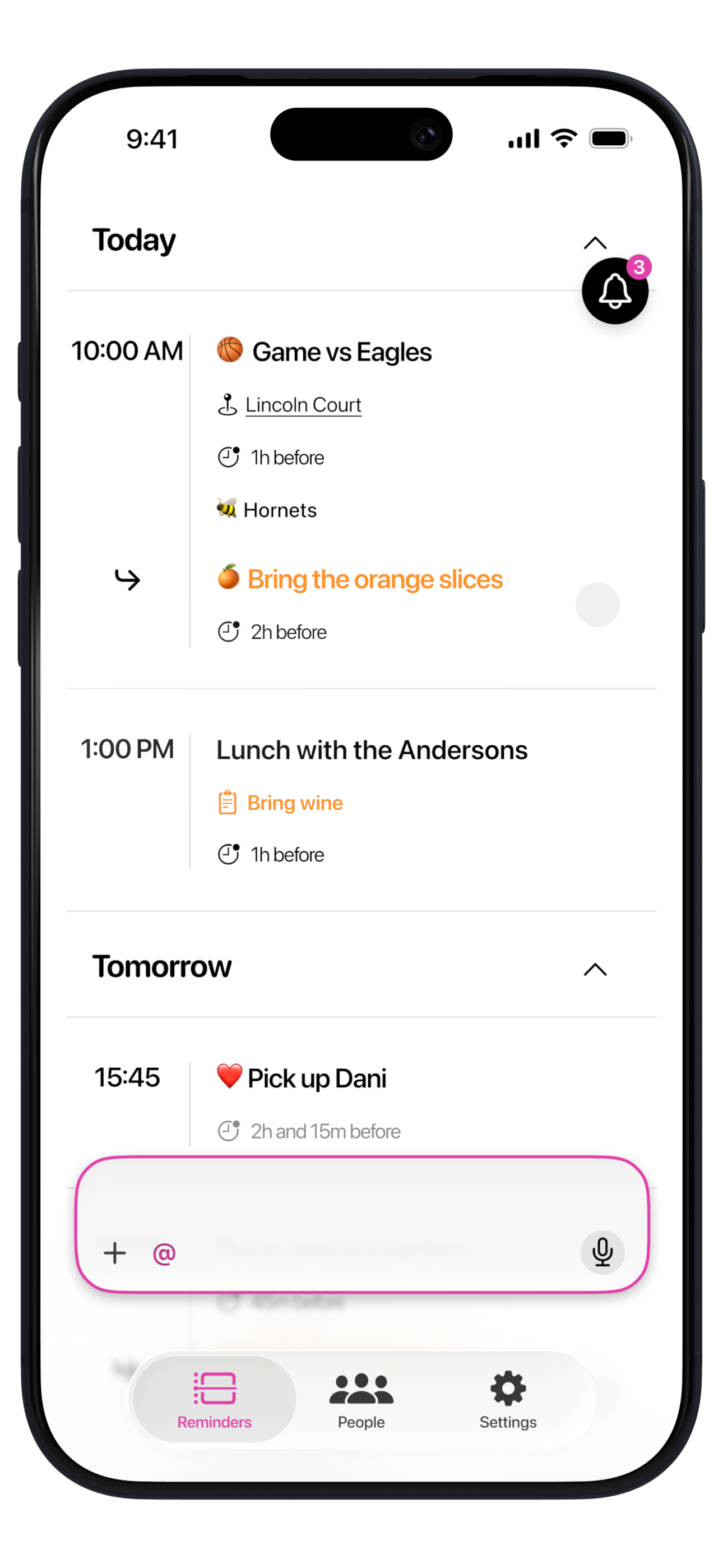
In most homes one parent quietly tracks every pickup, practice, and permission slip. A shared reminder app moves that invisible work onto a surface the whole family can see and act on.
If you are the parent who knows the dentist is on Thursday, that the cleats are a size too small, and that picture day means a clean shirt - you already know the feeling. The exhausting part of family life often is not the doing. It is the remembering: holding a hundred small open loops in one head, all the time, with no off-switch. That invisible work falls hardest on one person, and it is the share of it that tracks with burnout - not the chores themselves.
It is not the carpool that wears you down. It is being the only person who remembers there is a carpool.
Why "just tell me what to do" does not fix it
A common attempt at fairness is splitting the chores. But the imbalance in family life sits more in the thinking than in the doing - the anticipating and monitoring that quietly land on one person. And it is not something you can out-earn: a paycheck cuts physical chores but barely touches the mental load.
You can outsource the cleaning. You cannot outsource the noticing. A babysitter does the bath; nobody else is tracking that the form is due Friday. So the fix is not delegating harder - it is making the invisible visible, so the family runs on a shared surface instead of one person's memory.
What it looks like across a week
A family week doesn't arrive as tidy calendar entries. It arrives as a sentence in your head on a Monday night. So you just say it:
"Sam's got a game Saturday at 10am - the league fee's due Thursday, I'm on snacks this week, and his kit needs washing before then."
RemindMe reads that one line and hands back four cleanly-named reminders, each already timed for when you'd actually want it:
- ⚽ Sam's game - Saturday, 10am. The anchor everything else hangs off.
- 💰 Pay Sam's league fee - it hears "Thursday" as a hard deadline, starts reminding you a couple of days before, and keeps nudging until it's paid.
- 🧺 Wash Sam's kit - no time attached, but it knows the kit has to be clean and dry by Saturday, so it lands on a Wednesday evening, not late Friday night.
- 🍎 Bring snacks for the game - one job, two moments: a reminder earlier in the week to buy them, then another 30 minutes before kickoff to grab them on the way out.
You never said when to do any of it. RemindMe works that out itself, partly from understanding what each task takes (a fee is a hard date, a kit needs washing and drying time, snacks get bought once and brought later), and partly from what it's learned about how your days run. It knows you'd rather run errands in the evening than first thing, and that game-day mornings are already a scramble. Plain speech in, well-timed reminders out.
And you didn't have to sort the shared parts yourself. Sam's soccer lives in a shared sports group, so half of game day was on your phone before you said a word: the coach had already posted "arrive 9:30 for warm-up," and another parent had put up the carpool. Your four reminders just join the same surface - nobody re-typing what someone else already sorted.
That's the shift from a calendar or a to-do list: you say your part once, in the words you'd actually use, the group carries the shared part, and the app does the sorting, the timing, and the nudging that used to fall to one parent - so nothing pings once and vanishes, and nothing rots in the limbo of a list.
What about the shared calendar and the grocery list?
Most family organizers lead with two things: a color-coded shared calendar and a running grocery list. Both are genuinely useful, and RemindMe isn't trying to replace them - it's the layer that makes sure what's on them actually happens. A calendar shows that picture day is Friday; it doesn't lay out a clean shirt on Thursday night. A shopping list holds "milk, cleats, permission slip"; it doesn't nudge anyone to actually go buy them. Keep the calendar and the list if they work for you - RemindMe turns the things on them into a shared reminder that fires on the phones of the people you share it with, so remembering them stops being one parent's job.
Share it, do not assign it
The difference between delegating ("can you remember to grab the cake?") and redistributing (the reminder is shared, so everyone sees it and acts) is the whole game. Here is how RemindMe does the redistributing: jot a logistics detail however it lands on you, whether typed in a quick note, spoken aloud in any language, or snapped as a photo of the soccer flyer, and an AI planner works out what each thing really needs - whether it takes prep, when you could realistically do it, and how it should repeat. Share it with anyone in your contacts and it fires on their phone at the right time as their own reminder, and it shows up in their day's agenda on the Lock Screen too. No group chat, no forwarding, no "did you see my text." Contact matching happens on your device.
For the standing stuff, a Family group lets everyone see and add reminders to one shared surface - a soccer team, a co-parenting handoff, grandparents who do Tuesday pickups. The anticipating and monitoring stop being one person's silent job and become something the family simply does together.
It's a free iOS app, and your reminders are never used to train AI. Say the thing once. Let everyone remember.