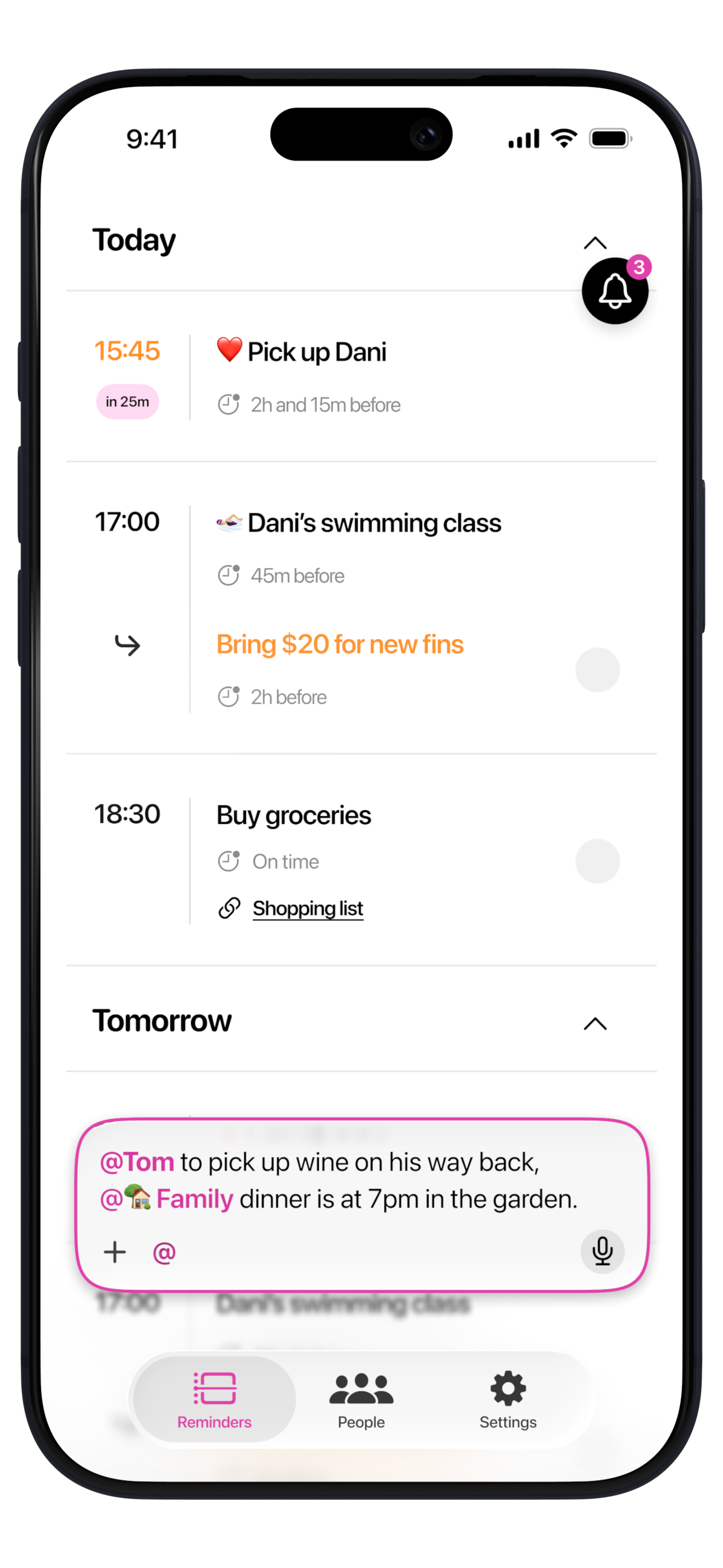
Any.do is a polished cross-platform planner you keep organized. RemindMe is a reminder engine that organizes itself - you say it, the AI works out what it is and when to nudge you, and an @mention shares the reminder onto both your phones.
A good planner gives you somewhere tidy to put everything: a to-do list, a calendar, a board for the project, a moment each morning to line up your day. That is real work, and Any.do does it across every device you own. But a place to put things still leaves the two hardest parts to you - getting the thing out of your head the instant it lands, and being nudged about it at the moment you can actually act.
That is the split here. Any.do is a surface you organize: you type each task, set its time, and review the plan yourself. RemindMe does the organizing for you - it reads what you send, works out what each thing is, and follows through on its own. One is a planner you maintain; the other works in the background like a second brain.
Any.do
One of the most established and genuinely cross-platform planners around - a to-do list, a calendar, and a daily review that live on every device you use.
Strengths
- Truly cross-platform - iPhone, Android, Windows, Mac, web, watch, even a Gmail add-on. If your devices are mixed, everything stays in sync, and RemindMe is iPhone-only for now.
- A real calendar and daily planner - a built-in calendar alongside "Moment," a once-a-day ritual where you walk through and plan your day task by task.
- Shared boards, family and team spaces - shared lists and project boards with task assignment, plus a Family plan with a shared space, a grocery list, and shared boards.
- A WhatsApp assistant that splits a message - send it a brain-dump and it breaks the one message into several separate tasks (a Premium feature).
Limitations
- The reminders are basic, and the good ones are paid - a standalone one-time reminder and simple recurring are free, but advanced recurring, location reminders, and WhatsApp reminders are all Premium. Nothing persists or auto-reschedules what you miss - overdue tasks sit in your Today and calendar views for you to drag to a new day yourself, and the guided Moment cleanup is capped at 5 a month on Free.
- The AI fills lists, it does not decide - "Any.do AI" (paid) breaks a task into subtasks and builds board checklists, but it only adds items you confirm. It does not work out what kind of task something is, or fill in a detail you leave out.
- A photo is only attached, never read - you can pin an image to a task, but nothing pulls the date or the details off a flyer or a screenshot for you.
- Most of the good stuff sits behind a paywall - the Free tier has no sharing, no AI, no WhatsApp, no location reminders, and caps the Moment planner at 5 a month. Premium runs about $60 a year and Family about $99.96 a year.
- Sharing is a shared list, not a nudge - every sharing feature is paid, and it shares lists and boards you both open. It does not push an individual reminder notification onto a specific person's phone.
RemindMe
An AI that does the organizing for you: say what is on your mind, however it tumbles out, and it comes back as reminders that each know what they are and when to nudge you.
Strengths
- Capture it however it comes out - say it in any language, type it, or snap a photo, screenshot or flyer, and it reads the details straight off the image. A messy sentence comes back as separate reminders.
- The AI actually thinks about what you tell it - it works out what each thing is, so you never sort, tag or file anything, and fills in what it can from common sense, what it has learned about you, and how things work where you live. Say 'after work' and it lands when your day usually ends; give it an exact time and it uses that. It keeps learning your people and preferences, so each time it needs less from you.
- It follows through so you do not have to - deadlines surface days ahead, open tasks nudge harder the more urgent they get, and anything you miss quietly reschedules to a new time you can act on, with no daily review to sit through.
- @mention a person or a group and the reminder becomes theirs too, set on their phone as their own. It is a real reminder, not a line in a shared list you both have to open. In a group, anyone can add reminders for everyone, so remembering is shared, not one person's job.
- Free, with generous AI limits - the whole app, no paywall.
Limitations
- iPhone-only today - Android is coming, but if you are on Android right now, or you want a Windows or web app, Any.do covers every platform and RemindMe does not yet.
Any.do gives you a tidy plan to review each morning. RemindMe does the remembering for you - and when you @mention someone, the reminder arrives on their phone too, not as a list they have to open.
Side by side
| RemindMe | Any.do | |
|---|---|---|
| Core model | You say it; the AI handles it | A planner you organize |
| Capture | ✓✓Voice, photo, docs - read | ✓Type or voice; photo not read |
| True AI brain | ✓✓Understands your task | ✗Just fills lists (paid) |
| Nudging | ✓✓Auto-nudges & reschedules | ✗Fixed alerts; extras paid |
| Sharing reminders | ✓✓To a person or group | ✓Shared lists (all paid) |
| Free tier | ✓✓Full app, generous AI limits | ✗No sharing/AI; Moment 5/mo |
| Platforms | iPhone (Android soon) | Every platform |
Why does the difference matter? Because most of what a busy day drops is not information, it is intentions, the things you meant to do, and those die in the gaps when you are interrupted. A reminder roughly doubles your follow-through1, but only when the cue lands in front of the person it is for at the moment they can act, not as a line in a list someone still has to open. And the load that falls most unequally, the invisible anticipating and monitoring, is exactly what sharing lifts: @mention a person or a group, and anyone can add reminders for everyone, so whoever you share it with carries the remembering too, not just one person.
The verdict
Pick RemindMe if you want to say a thing once and trust it is handled. Speak it, type it or snap a photo, and it becomes the right reminder: the AI works out what it is, times it when it can, and nudges until it is done. @mention a person or a group and it is shared onto their phone too. No morning planner to work through, no paywall, and it does the organizing you would otherwise do by hand.
The one real reason to choose Any.do is reach: it runs on iPhone, Android, Windows, Mac, web and watch, while RemindMe is iPhone-only for now (Android is coming). If your devices are mixed today, or you love a Moment-style plan-your-day ritual, Any.do covers more ground. But its reminders stay fixed-time, its AI only fills in lists you confirm, and nearly everything worth having (sharing, AI, location) sits behind Premium.